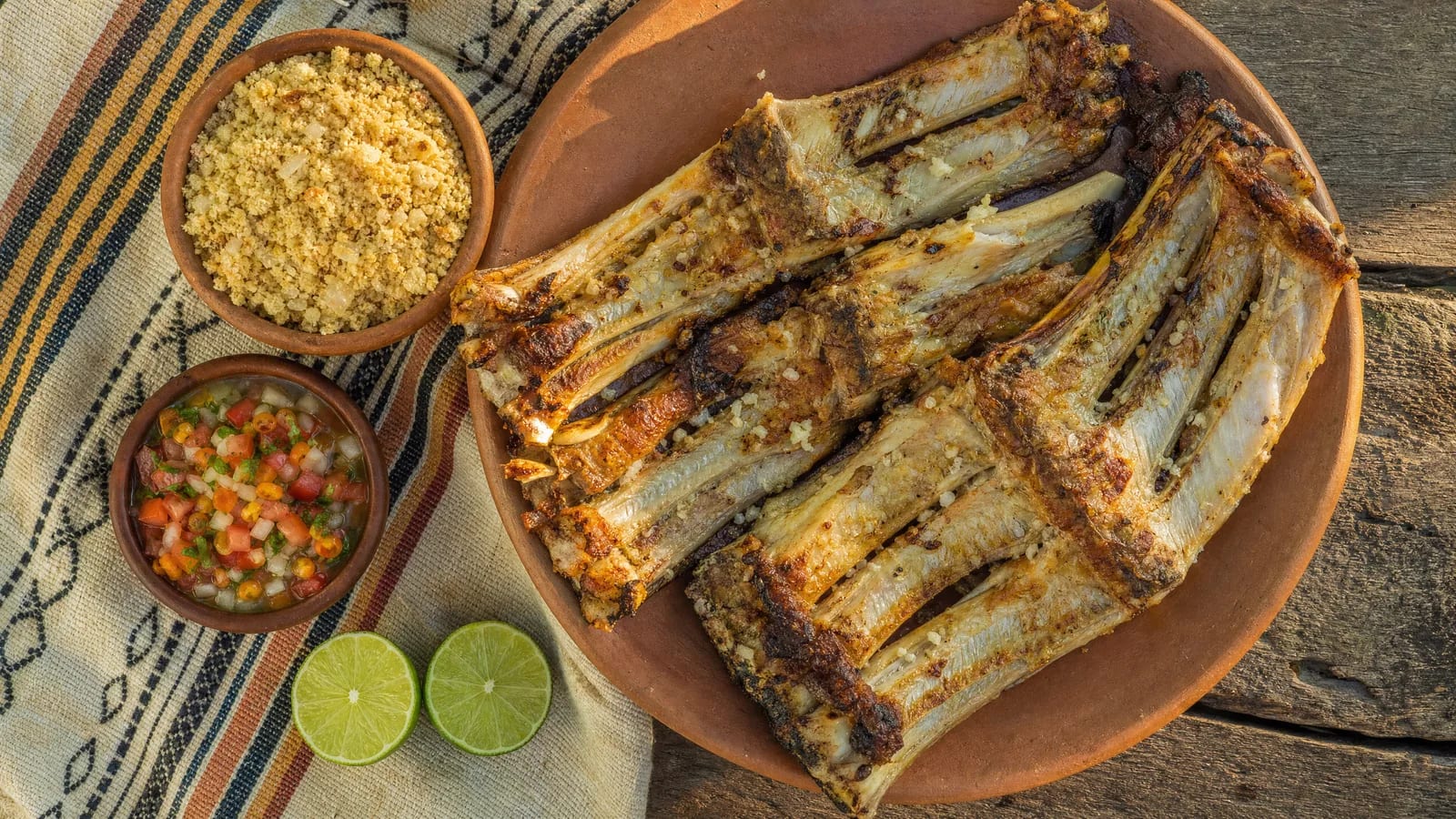


Late afternoon in Boa Vista has a scent: tambaqui rib fat dripping onto the coals, lifting sweet smoke over the backyard. The broad white flesh browns at the edges and stays juicy at the center, while farofa crackles and the vinaigrette cuts through with fresh acidity. It is the barbecue Roraima made for itself—in place of pasture-raised beef, a giant of the river.
Behind the flavor
If Roraima's interior has damurida—a chili-laced fish soup—Boa Vista has tambaqui ribs over coals. Tambaqui is one of the Amazon's largest scaled fish, and its ribs—fatty, broad, and full of meat—have become a symbol of Roraima's good table, found at celebrations, on riverbanks, and in the capital's barbecue restaurants. It is the dish that shows how Roraima made barbecue its own: in place of beef, river fish; in place of southern Brazilian grasslands, Amazonian heat. Gathering the family around tambaqui ribs over coals is as natural there as a Sunday barbecue anywhere in Brazil.
📜 Ingredients
- 🐟tambaqui ribs (with meat), in pieces1.5 kg (3.3 lb)🔁 pirarucu ribs or firm, fatty white-fish steaks — It is an adaptation, but tambaqui ribs have distinctive flesh and fat that define the dish's flavor.
- •coarse saltto taste
- •crushed garlic4 cloves
- •lemon juicefrom 2 lemons
- 🌶️chopped pimenta-de-cheiro1 to 2, to taste🔁 seeded dedo-de-moça chile pepper — It keeps the mild heat, but pimenta-de-cheiro is more aromatic than hot.
- •cassava flour (for the farofa)2 cups
- •butter (for the farofa)3 tablespoons
- •chopped onion (for the farofa)1 medium
- •tomatoes for the vinaigrette2
- •red onion for the vinaigrette1
- •chopped parsley and scallions1 small bunch
- •vinegar and olive oil (for the vinaigrette)to taste
👨🍳 Method
- 1
Clean and thoroughly pat the tambaqui ribs dry.
A dry surface helps the coals brown the fish rather than steam it.
- 2
Season with coarse salt, garlic, lemon juice, and pimenta-de-cheiro; let stand for 20 to 30 minutes.
Lemon firms the flesh and tempers that strong river aroma.
- 3
Light the barbecue and wait until the coals reach medium heat, with no high flames.
High flames burn the skin and leave the center raw—fish ribs ask for gentle coals and patience.
- 4
Grill the ribs starting on the skin-and-bone side, turning only a few times, until the flesh is white, juicy, and golden at the edges.
- 5
While the fish grills, make the farofa: melt the butter, brown the onion, and add the cassava flour, stirring until loose and lightly toasted.
Stir constantly so the flour toasts evenly without burning.
- 6
Make the vinaigrette by mixing chopped tomato, red onion, and parsley and scallions with vinegar, olive oil, and salt.
- 7
Serve the grilled ribs with farofa and vinaigrette, with lemon on the side.
A squeeze of lemon at the table brightens the flavor of the smoked fish.
🥃 Pairing
With cachaça
Unaged cachaça from an alambique
Citrusy and herbal
It pairs with fish and cuts through tambaqui's fat, refreshing the palate between bites.
Cachaça rested in bálsamo wood
Lightly woody and smooth
It complements the coals' smokiness without covering the fish's delicate sweetness.
Also pairs well with
💡 Quick tips
- •Medium coals and few turns: grilled fish asks for patience, not haste.
- •Do not overdo the salt before grilling—adjust it afterward, at the table.
- •The farofa can take a little of the fat dripping from the fish for extra flavor.
🤔 Did you know?
Tambaqui fattens on fruit and seeds that fall into the water during the flood season—and has teeth like human molars, strong enough to crack Brazil nuts and pits. By eating and then spreading those seeds through the flooded forest, it becomes a true planter of the igapó: the fish you grill over coals helps replant the Amazon.
Small discoveries
- Tambaqui · ingredient
- A large-scaled fish of Amazonian rivers, with white, fatty, gently sweet flesh; the ribs are among its most prized cuts.
- Pimenta-de-cheiro · ingredient
- A highly aromatic Amazonian chile pepper with mild heat, used to perfume fish and broths in Brazil's North Region.
- Farinha d'água · ingredient
- A fermented, moister cassava flour typical of Brazil's North Region, with coarser grains and a pronounced flavor; it is the base of farofas and the region's pirão.
- Igapó · cultural expression
- Amazonian forest flooded during the rivers' high-water season; in this inundated habitat, tambaqui feeds on fruit and seeds and helps disperse them.
📚 References
- Embrapa — pesquisas sobre o tambaqui, a frugivoria e a piscicultura na Amazônia
- IBGE — dados sobre a produção pesqueira e a aquicultura na região Norte
- Raul Lody — obras sobre a gastronomia brasileira e os peixes de água doce
Keep discovering