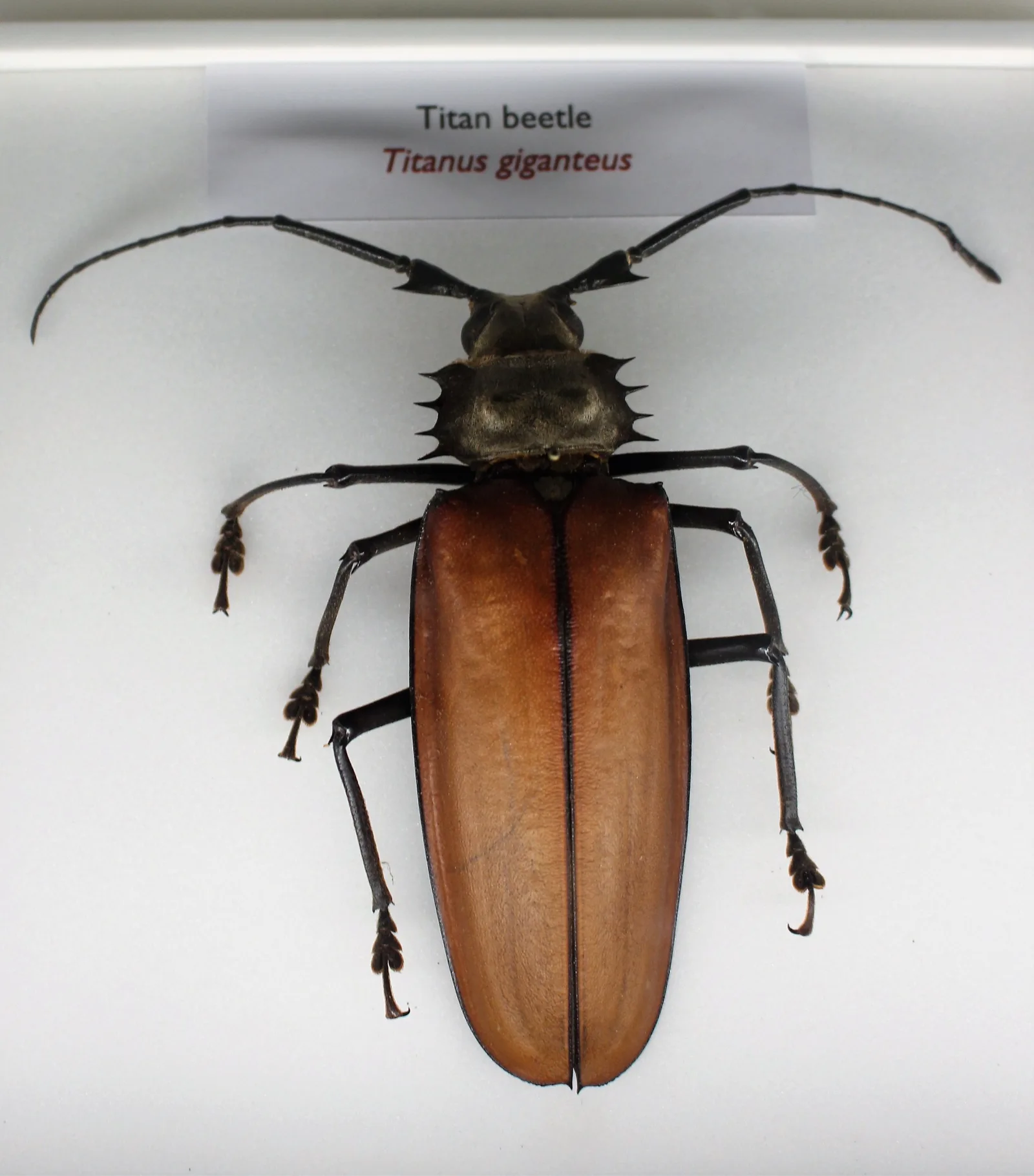
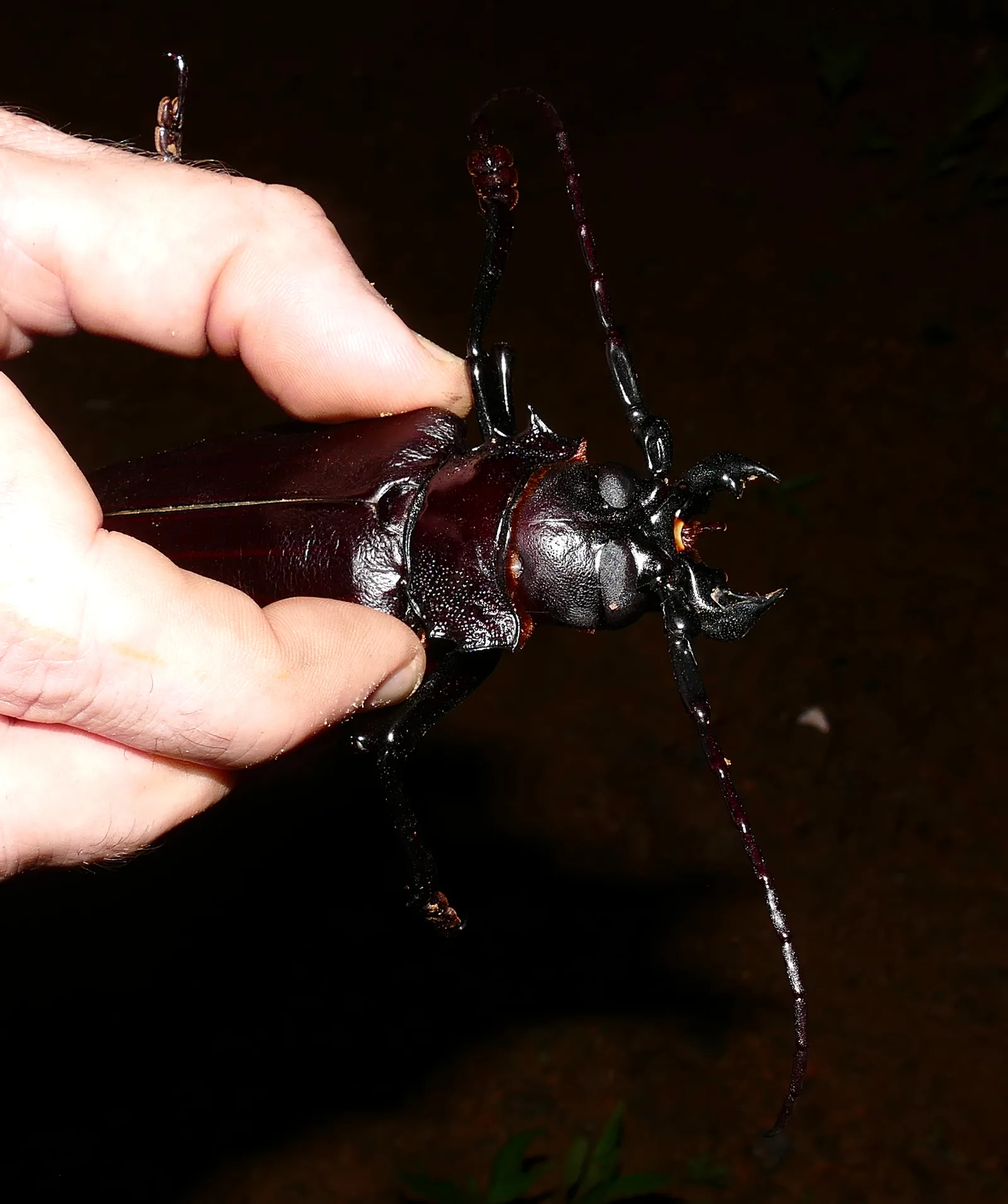
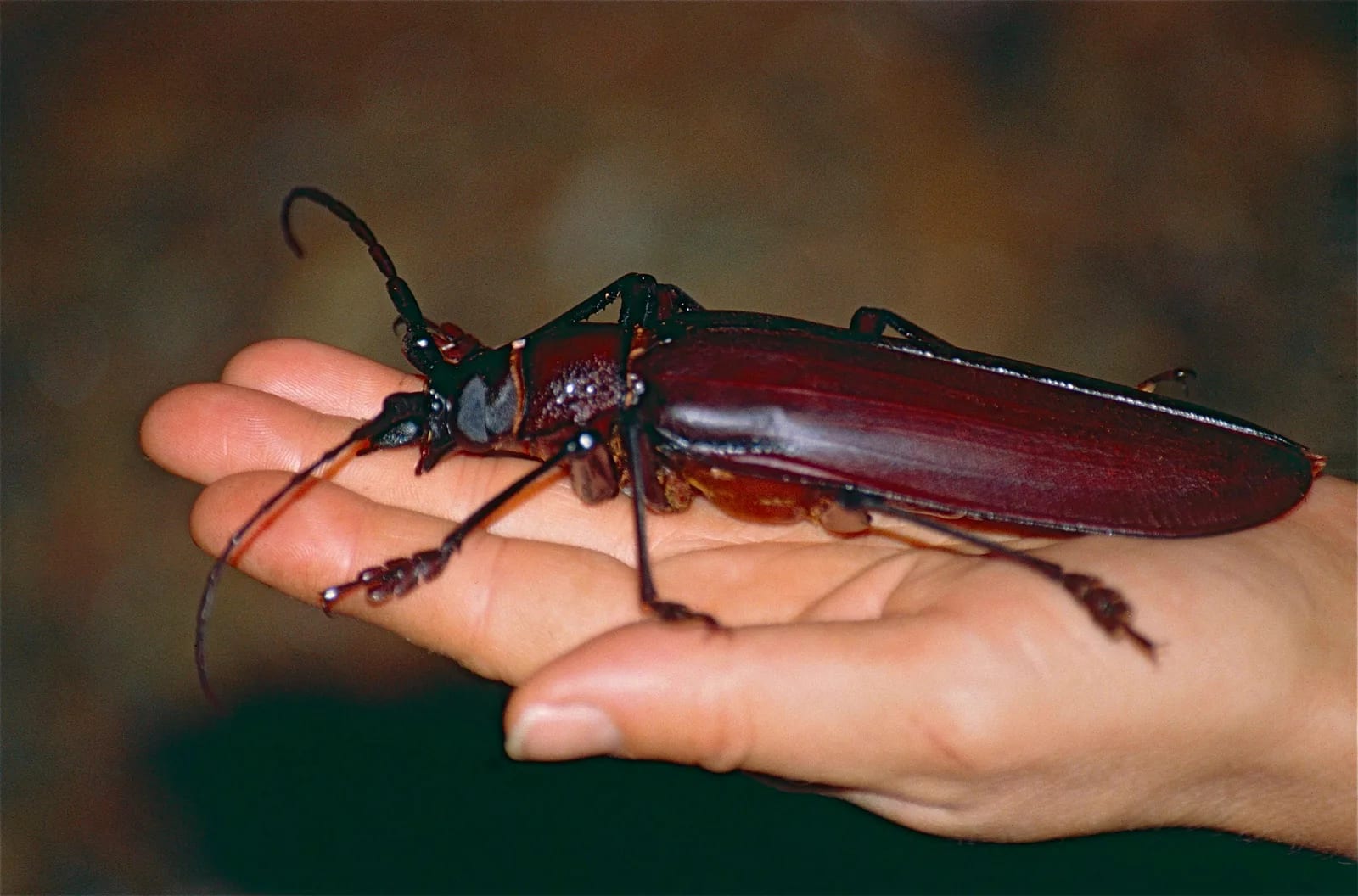
Titan beetle
Titanus giganteus
Insects — Coleoptera (Cerambycidae)
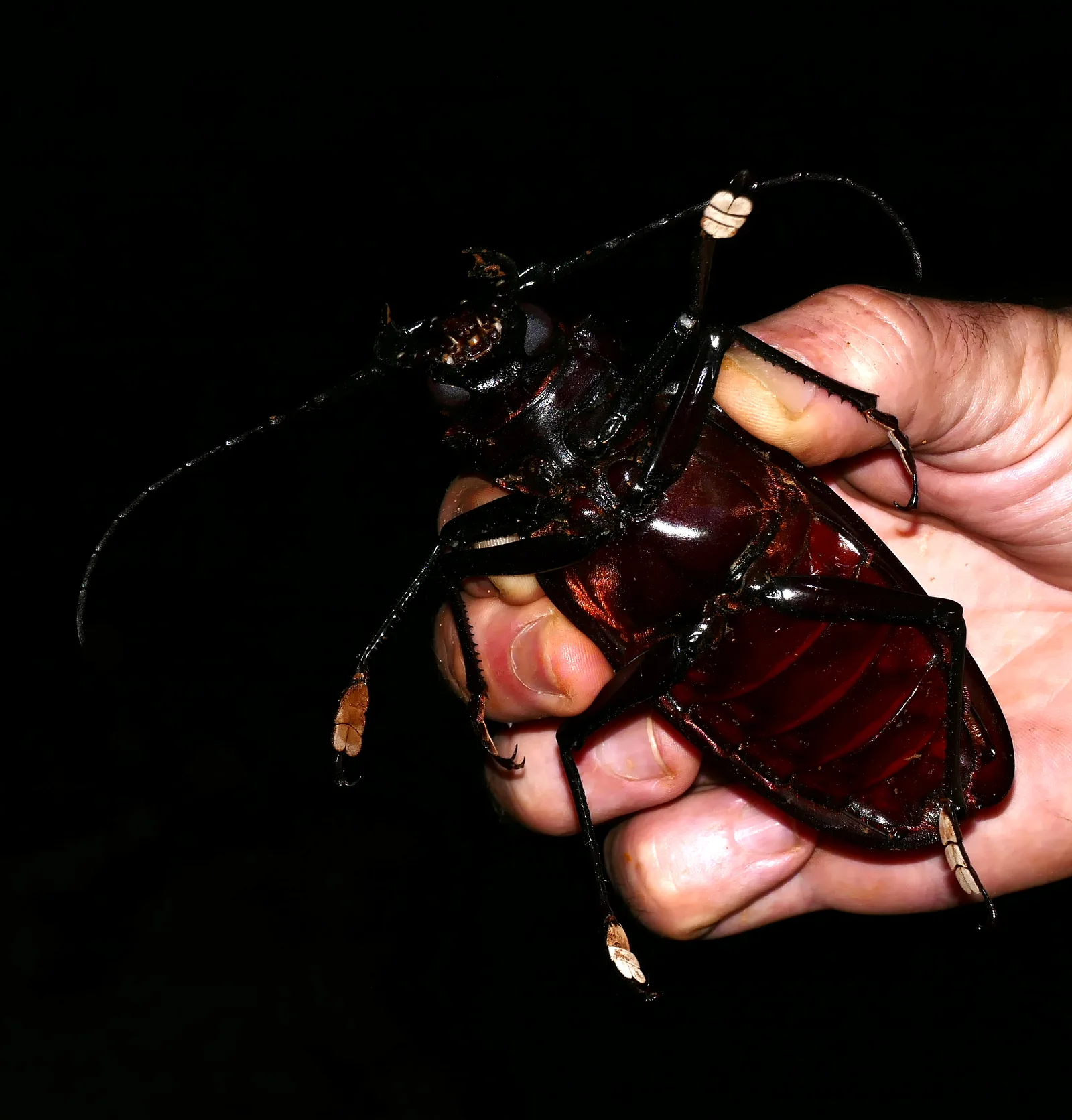
Titanus giganteus is often cited as one of the planet’s largest insects. Its extraordinary size is no legend: it marks the physical limit of what an insect can become in dense, hot, biologically rich tropical forests.
The silent giant of mature forests
Seeing a live Titanus giganteus is rare. It spends nearly its entire life beyond human reach, appearing chiefly at night during its adult stage. Its gigantism is the result of an ecologically stable environment, where resources and space have allowed insects to attain striking proportions.
📍 Range and habitat
Distribution: Amazon Basin, with records from Brazil, the Guianas, Venezuela, Colombia, Ecuador, and Peru.
Habitat: lowland humid tropical forests, especially areas with mature trees and abundant dead wood.
⚠️ Relationship with humans
Conservation: a species with no individual assessment on the IUCN Red List (Not Evaluated). Its occurrence is strongly associated with mature forests, making it sensitive to habitat loss.
Relationship: not venomous or aggressive, but if handled, it can inflict painful pinches with its extremely strong mandibles. It is also targeted by illegal collecting for trade and entomological collections.
🔬 Scientific classification
- Kingdom
- Animalia
- Phylum
- Arthropoda
- Class
- Insecta
- Order
- Coleoptera
- Family
- Cerambycidae
- Genus
- Titanus
- Species
- Titanus giganteus (Linnaeus, 1771)
🔬 Morphology and adaptations
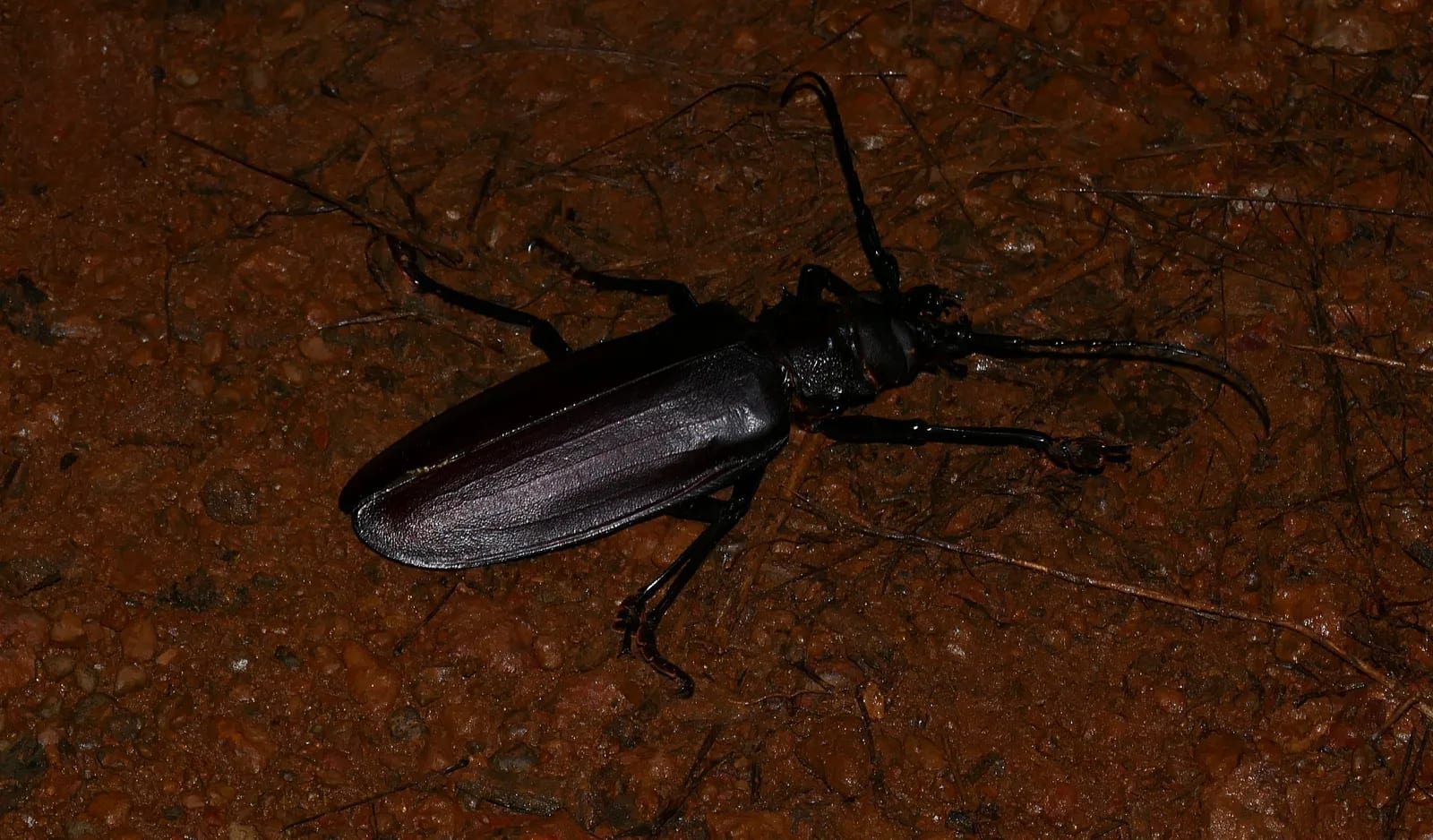
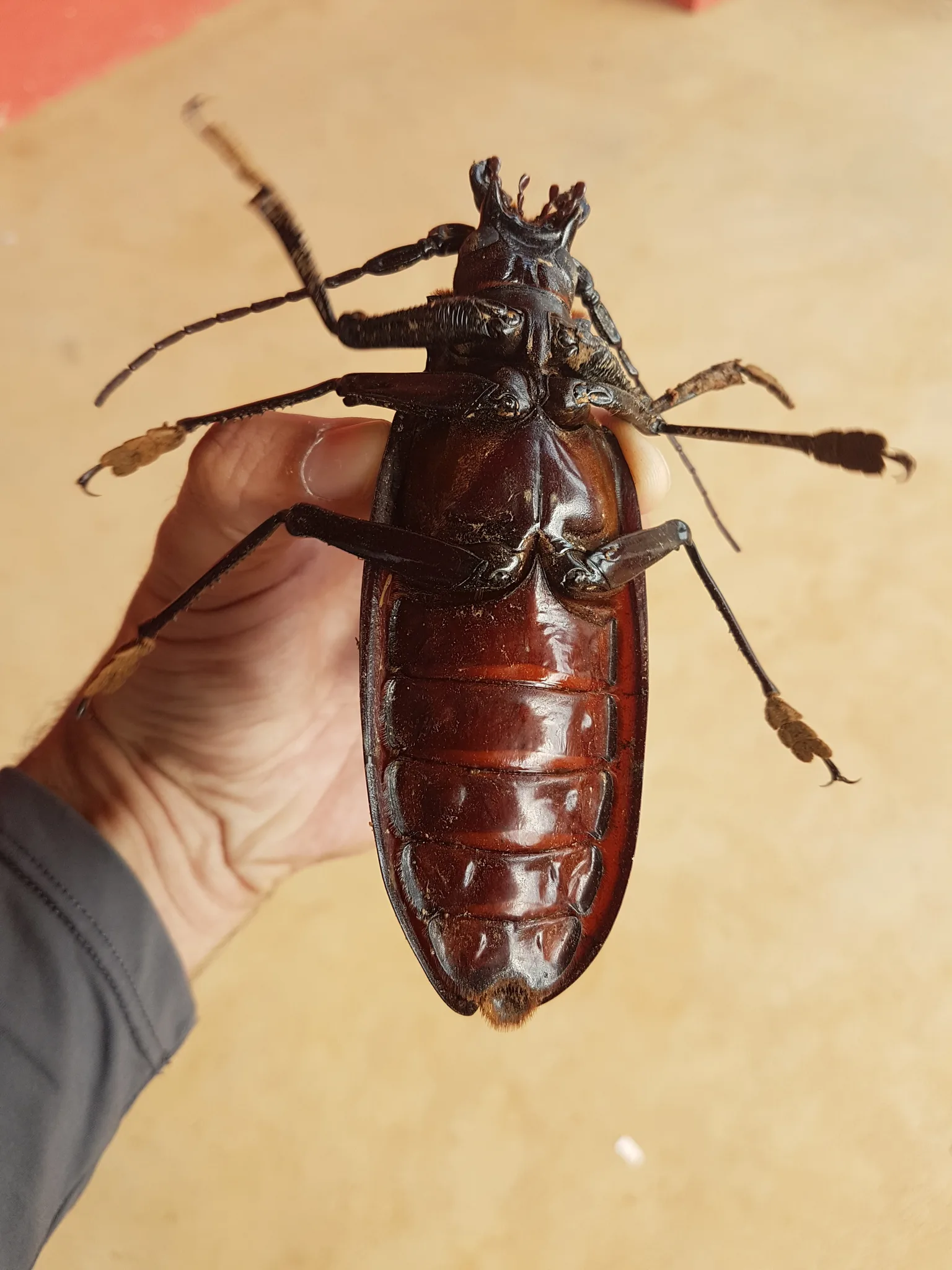
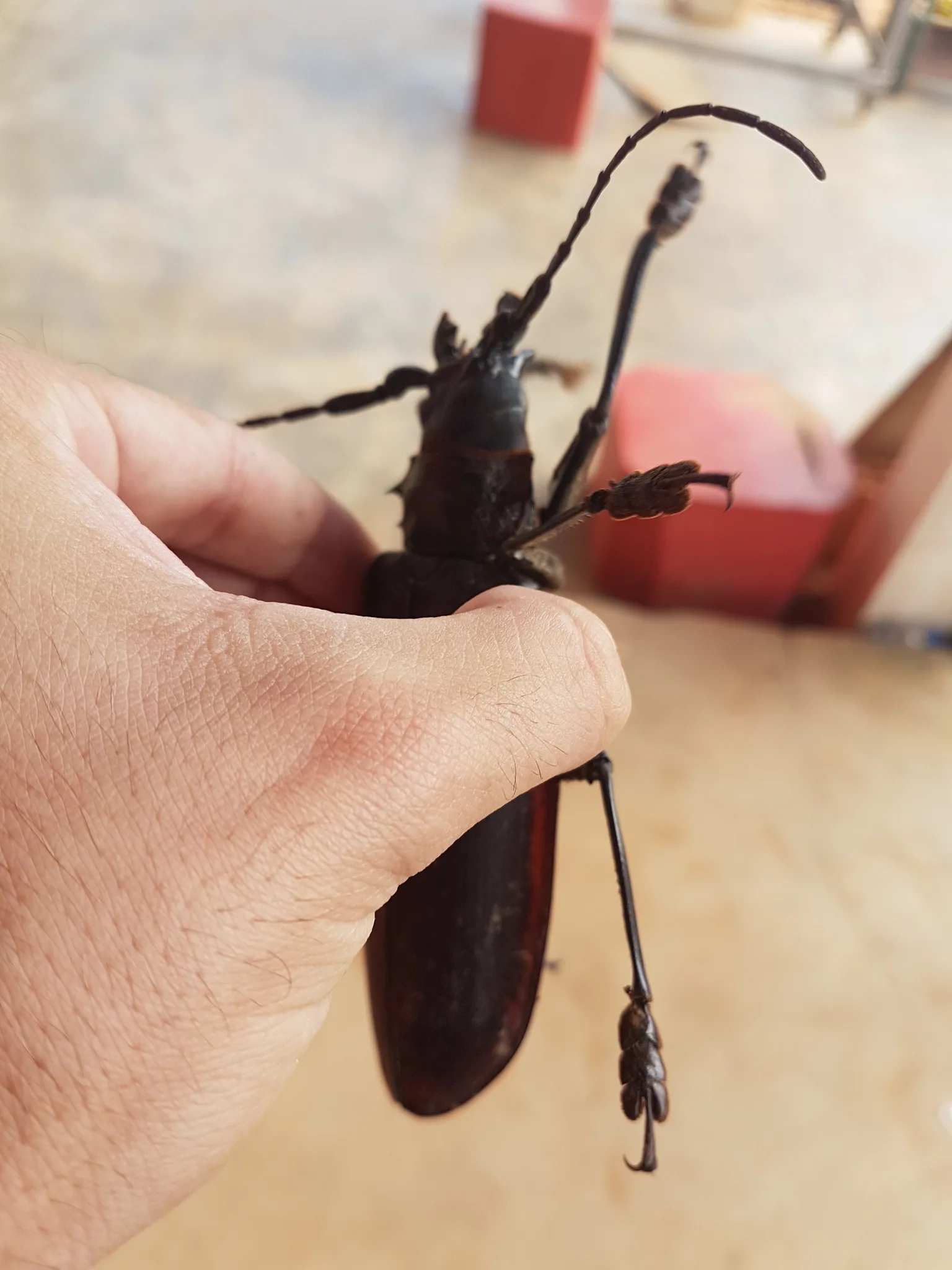
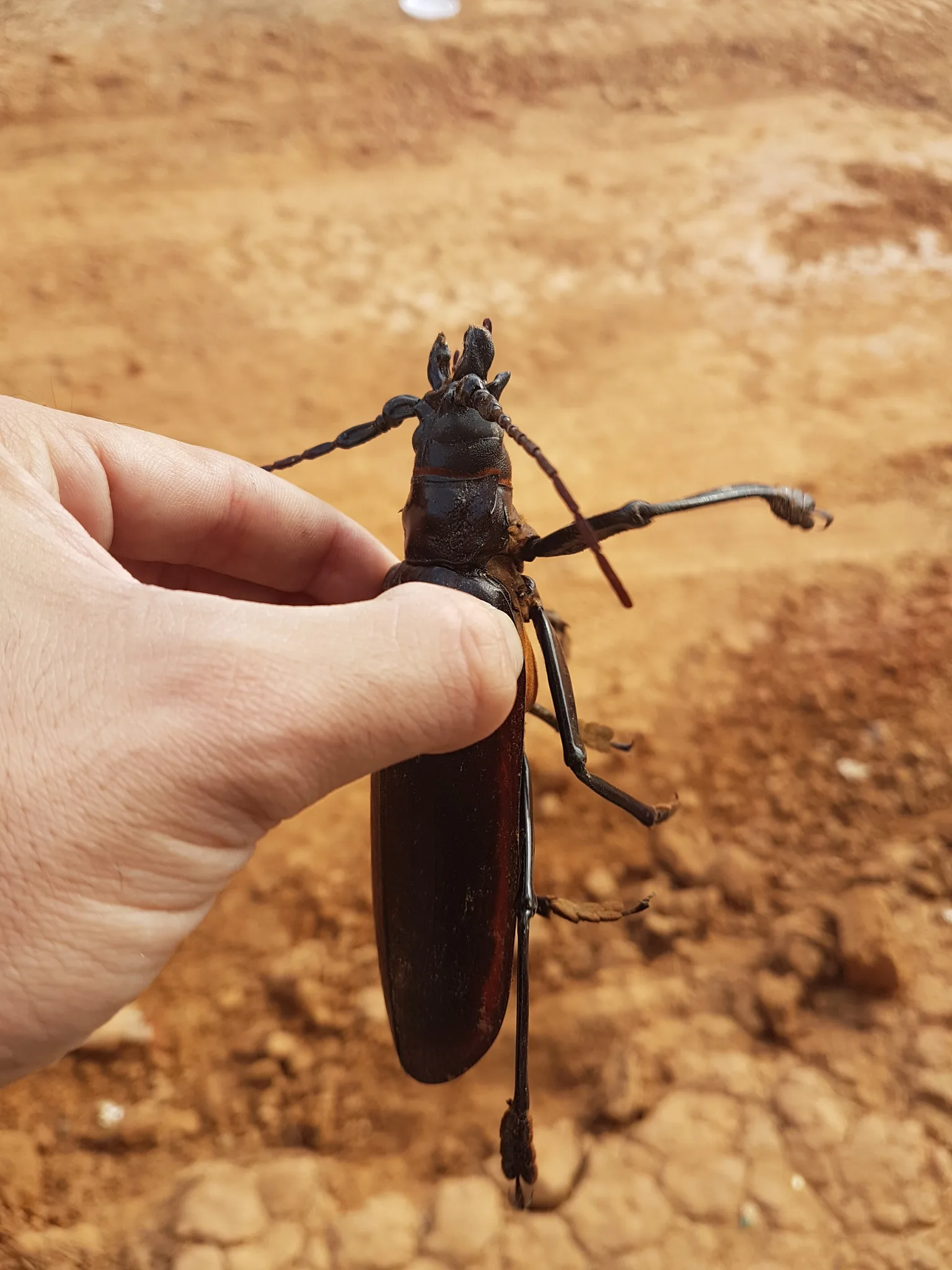
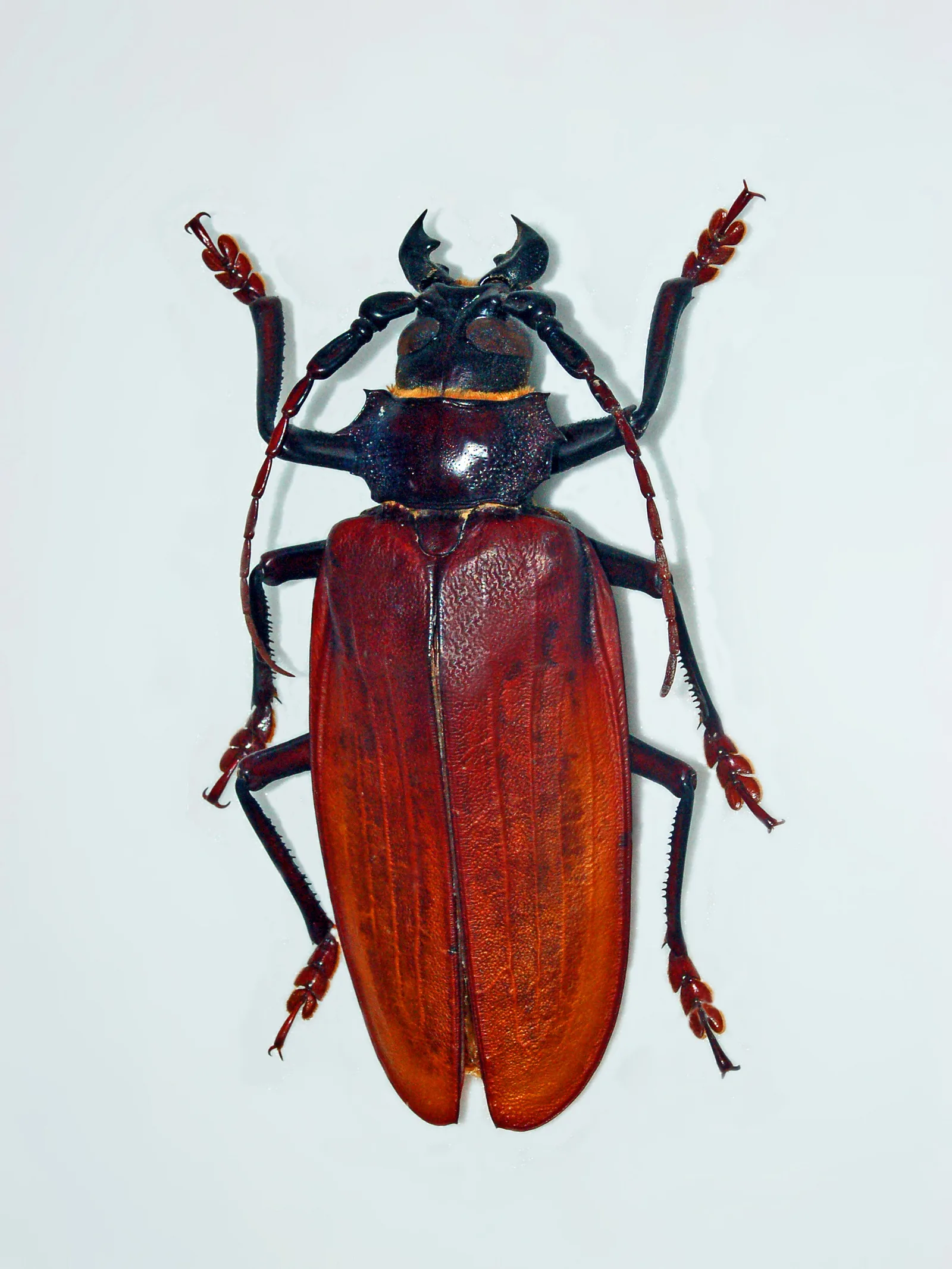
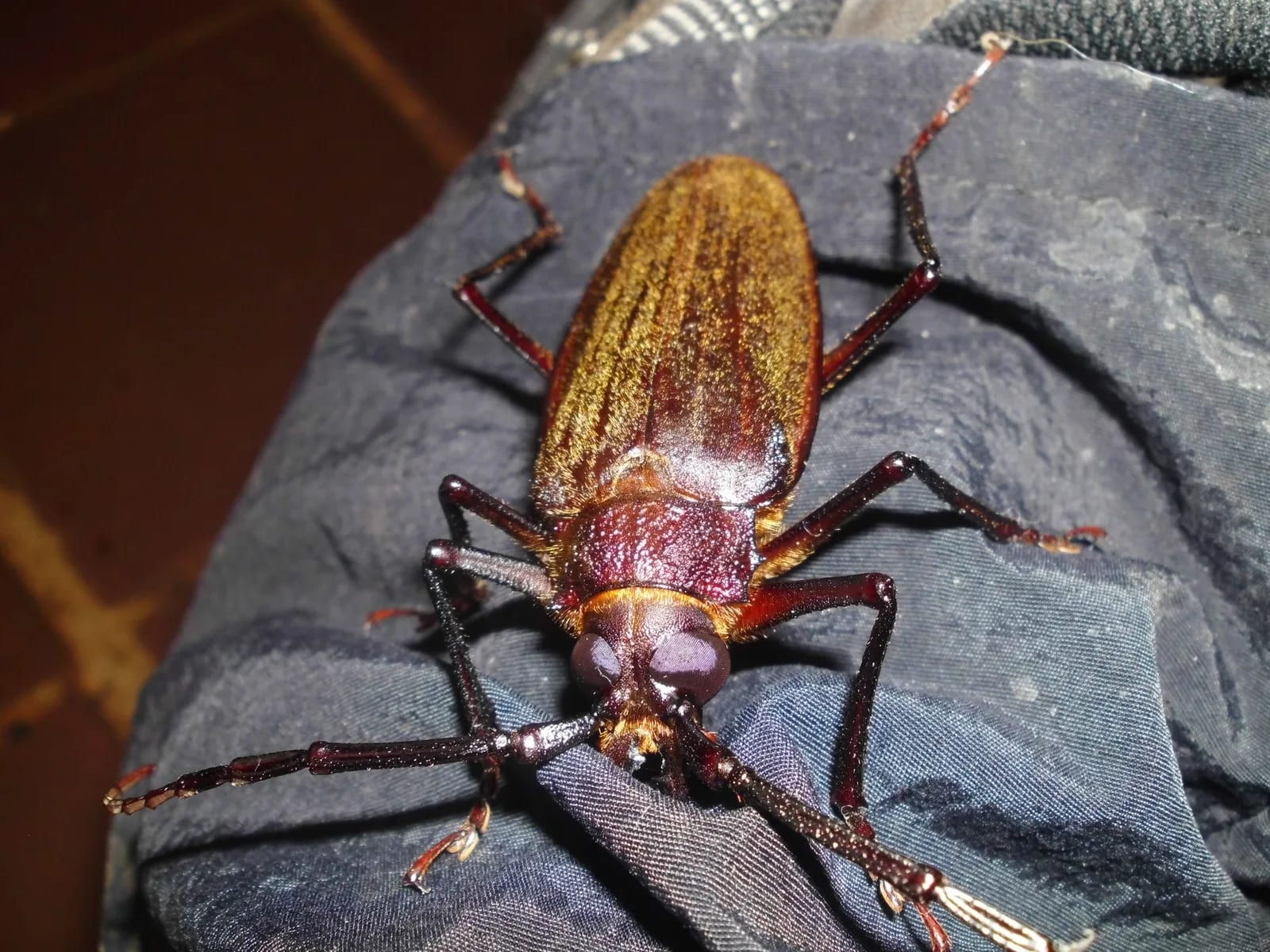
- Size: It can exceed 16–17 cm (6.3–6.7 in) in body length, placing it among the largest known insects.
- Jaws: Extremely robust, capable of exerting great mechanical force.
- Antennae: Long and segmented, essential for chemical and tactile orientation in the dark.
- Exoskeleton: Thick and resilient, offering protection from predators.
- Coloring: Dark brown to black, aiding nighttime camouflage.
Diet: Xylophagous larvae — they feed on decomposing plant tissue inside wood; adults scarcely feed, living on reserves accumulated during the larval stage.
🔄 Life cycle and behavior
📅 Development
- Type: complete metamorphosis: egg → larva → pupa → adult.
- Larvae: they live for several years inside wood, feeding on decomposing plant tissue.
- Adults: a short phase focused almost exclusively on reproduction.
🌙 Behavior
- Activity: nocturnal, often attracted to artificial lights.
- Flight: heavy and noisy, yet functional despite its size.
- Defense: an intimidating posture and the use of its mandibles.
🌍 Role in the Ecosystem
- Wood recycling: larvae help decompose logs, speeding the return of nutrients to the soil.
- Forest indicator: associated with mature, lightly degraded forests.
- Energy in the web: connects dead wood to larger predators.
💡 Why does it matter?
- Because it reveals the physical limits of insect life.
- Because it depends directly on intact tropical forests.
- Because rare species may disappear before they are even studied.
- Because fascination can also be a powerful tool for conservation.
💫 Why is this beetle so striking?
Titanus giganteus challenges our idea of an “insect.” Large, heavy, and powerful, it nonetheless depends on something extraordinarily fragile: continuous, old, complex forests.
When those forests disappear, silent giants such as this one vanish first — often before we notice.
Reflection: protecting the Amazon is not only about saving trees; it is about ensuring that even the most extraordinary forms of life remain possible.
Small discoveries
- Ecologically stable
- Older ecosystems with little climatic variation and high stability over time.
- Mature trees
- Old, large trees with dense wood and long growth cycles.
- IUCN
- The global extinction-risk list maintained by the International Union for Conservation of Nature.
- Mature forests
- Older forests with large trees and long ecological cycles.
- Habitat loss
- Deforestation, fragmentation, and degradation of tropical forests.
- Painful pinches
- A defensive pinch with extremely strong mandibles if handled.
- Exert great mechanical force
- Apply enough force to break thin branches or rigid materials.
- Nighttime camouflage
- Difficulty of visual detection in low-light settings.
- Complete metamorphosis
- A cycle with distinct stages: egg → larva → pupa → adult.
- Nocturnal
- Active chiefly at night.